-1.png?w=1976&h=824)
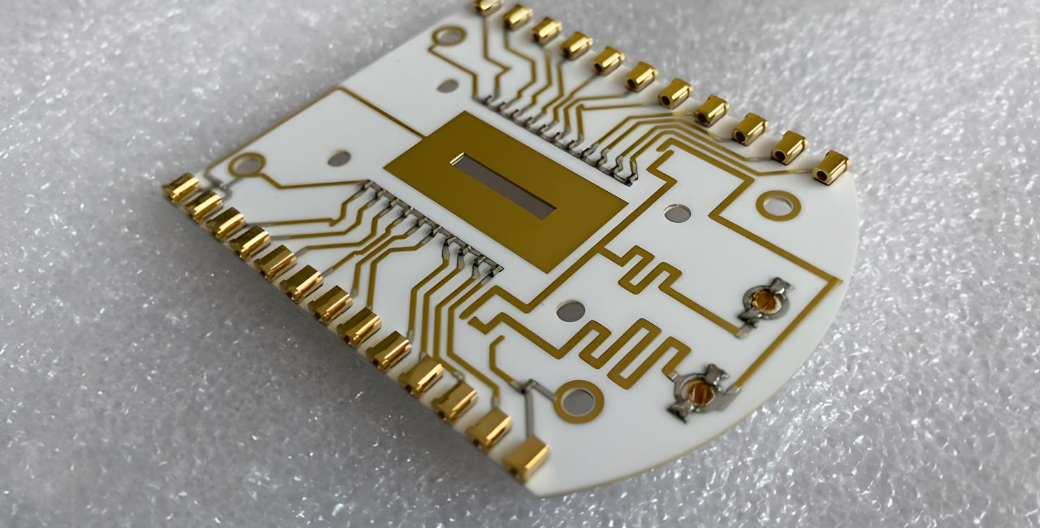
Beyond FR‑4: How Ceramic PCBs Are Powering Next‑Gen Electronics
Introduction
As electronics become more powerful, compact, and mission-critical, traditional FR‑4 circuit boards—made from fiberglass‑epoxy—are starting to hit their limits. Enter ceramic PCBs, engineered from materials like alumina (Al₂O₃), aluminum nitride (AlN), beryllia (BeO), and silicon carbide (SiC), which offer unmatched performance in advanced applications.
Why Ceramic Substrates Outperform FR‑4
1. Superior Heat Management
REF: FR‑4 → ~0.8–1.1 W/m·K vs. Alumina → ~28–35 W/m·K; AlN → ~140–180 W/m·K; BeO → ~170–280 W/m·K.
These thermal advantages reduce hotspots, extend component life, and enable high-power circuit miniaturization in compact designs .
2. Lower Thermal Stress
Ceramics exhibit CTE (coefficient of thermal expansion) closer to copper and semiconductor materials, reducing mechanical stress and solder joint fatigue seen in FR‑4 during temperature swings.
3. Enhanced Electrical Performance
With high dielectric strength and low dielectric loss, ceramic PCBs are ideal for high-frequency applications like RF, microwave, and 5G systems.
4. Mechanical Strength & Harsh Environment Resistance
Rigid and vibration-resistant, ceramic boards withstand extreme environments—be it aerospace, military, industrial automation, or EVs.
Core Applications Lighting the Future
- Aerospace & Defense – Used in avionics, satellites, radar, and weapons systems, ceramic PCBs survive temperature extremes, radiation, and mechanical shock.
- Automotive & EVs – Crucial for battery management, inverters, ADAS, and LED headlamps—especially in high-temperature, high-vibration environments.
- LED & Lighting – Their thermal efficiency supports long-life, high-power LED modules used in automotive & surgical lighting.
- Telecom/5G – Ceramic PCBs deliver signal integrity in RF circuits, base stations, and microwave links.
- Medical & Industrial – Reliable performance in implants, diagnostics, power converters, and manufacturing equipment.
Types of Ceramic PCBs
|
Type |
Thermal Conductivity |
Strengths & Specs |
|
Alumina (Al₂O₃) |
28–35 W/m·K |
Cost-effective, general-purpose high-temp and power handling |
|
Aluminum Nitride (AlN) |
140–180 W/m·K |
High thermal output, low dielectric loss, used in RF, SAW sensors, MEMS |
|
Beryllia (BeO) |
170–280 W/m·K |
Extreme thermal paths—but limited use due to toxicity |
|
Silicon Carbide (SiC) |
High, rugged |
Harsh environment use, radiation resistance |
|
LTCC / HTCC |
Multilayer co-fired |
Embedded passives, miniaturized RF hybrids |
Manufacturing Highlights
- Thick-Film & Screen-Printing: Ceramic traces of copper/gold baked onto substrate at ~1,000 °C in nitrogen.
- Co-Firing (LTCC/HTCC): Multilayer boards fabricated via lamination and kiln firing—LTCC (<1,000 °C), HTCC (~1,600 °C)—allowing embedded inductors, capacitors, and vias.
- Laser Processing & Drilling: Enables precise vias and shaping in stubborn ceramic materials.
Challenges & Design Trade‑offs
- High Cost: Materials and precision processes cost more, so ceramics are typically used only where performance justifies expense.
- Brittle Nature: Susceptible to cracking—usually limited to small PCBs and must be handled carefully.
- Limited Supply Chain: Fewer qualified suppliers and longer lead times compared to FR‑4.
- Complex Designs: Thermal, mechanical, dielectric properties must be carefully modeled during design phases.
Looking Forward
- Market Growth in EVs, 5G, aerospace, and medical drives increased demand for ceramic PCBs.
- Material Innovation: New ceramics (e.g., silicon nitride, PDCs) and composites offer better thermal/electrical performance.
- Integration and Miniaturization: Co-fired, embedded passives, and hybrid ceramic‑FR‑4 multilayers reduce size and enhance function.
- Environmental Focus: Ceramics are recyclable and chemically stable, helping cut e‑waste and improve sustainability.
- Advanced Manufacturing: Expect more automation, 3D shaping, and customized circuits to support next-gen systems.
Conclusion
Ceramic PCBs offer a compelling upgrade over FR‑4 in high-temperature, high-frequency, and harsh-environment applications. Though more costly and brittle, their extraordinary thermal management, electrical performance, and ruggedness are critical for future-proof electronics—especially in aerospace, EVs, 5G, medical, and industrial sectors. With ongoing material and manufacturing advancements, ceramic PCB technology is set to be a cornerstone of next-generation electronics.
Related Links:
https://www.marketresearchintellect.com/blog/ceramic-based-pcbs-the-future-of-high-performance-electronics/
https://wellsengineeredproducts.com/2019/12/20/power-electronics-advantages-of-ceramic-substrates-over-fr-4/
https://en.wikipedia.org/wiki/Thick-film_technology
https://www.nextpcb.com/blog/ceramic-pcbs
https://arshon.com/blog/understanding-ceramic-pcbs-an-in-depth-exploration
https://pcbmake.com/ceramic-substrates-pcb
https://jarnistech.com/ceramic-pcb